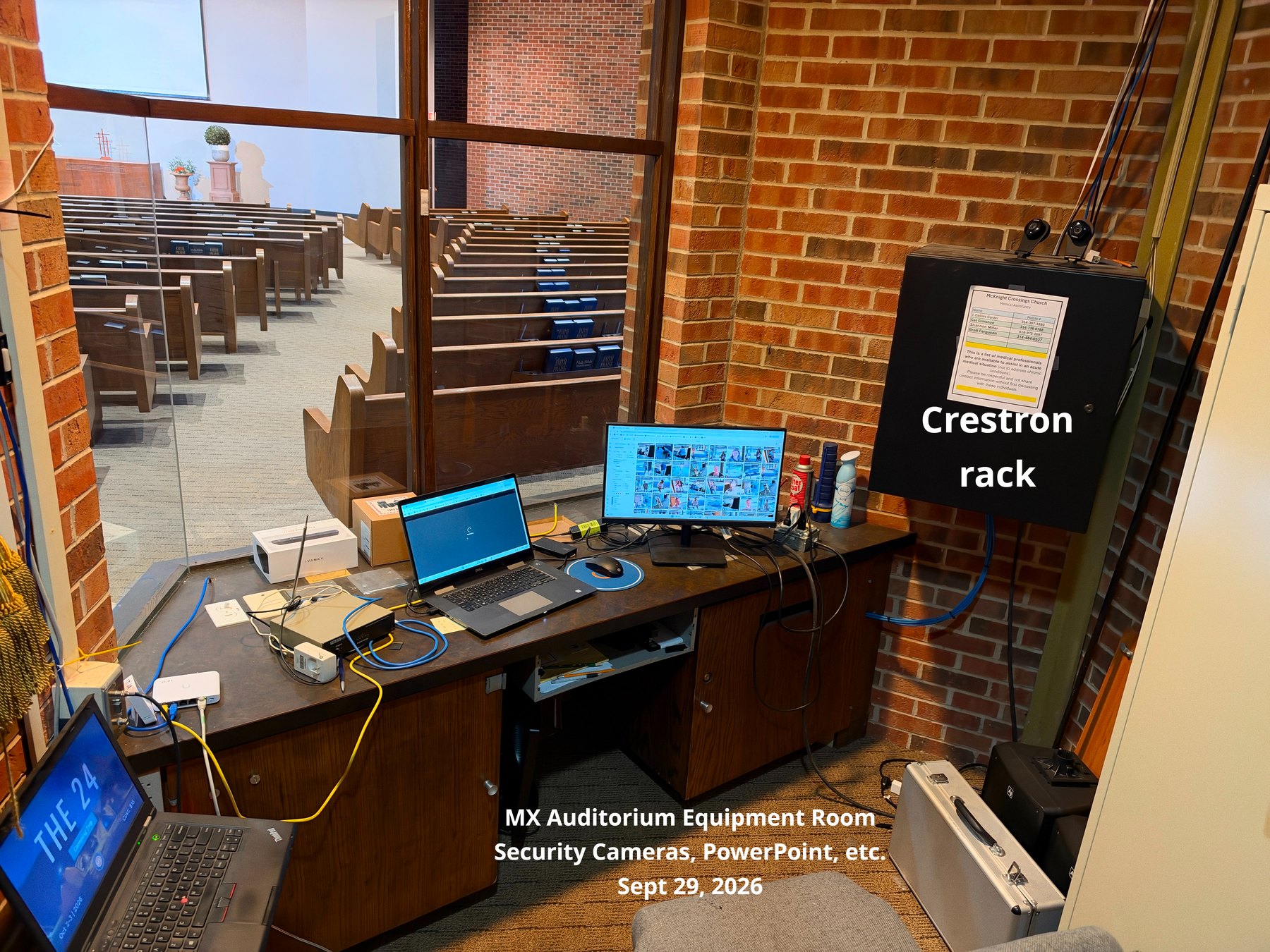
Current control system
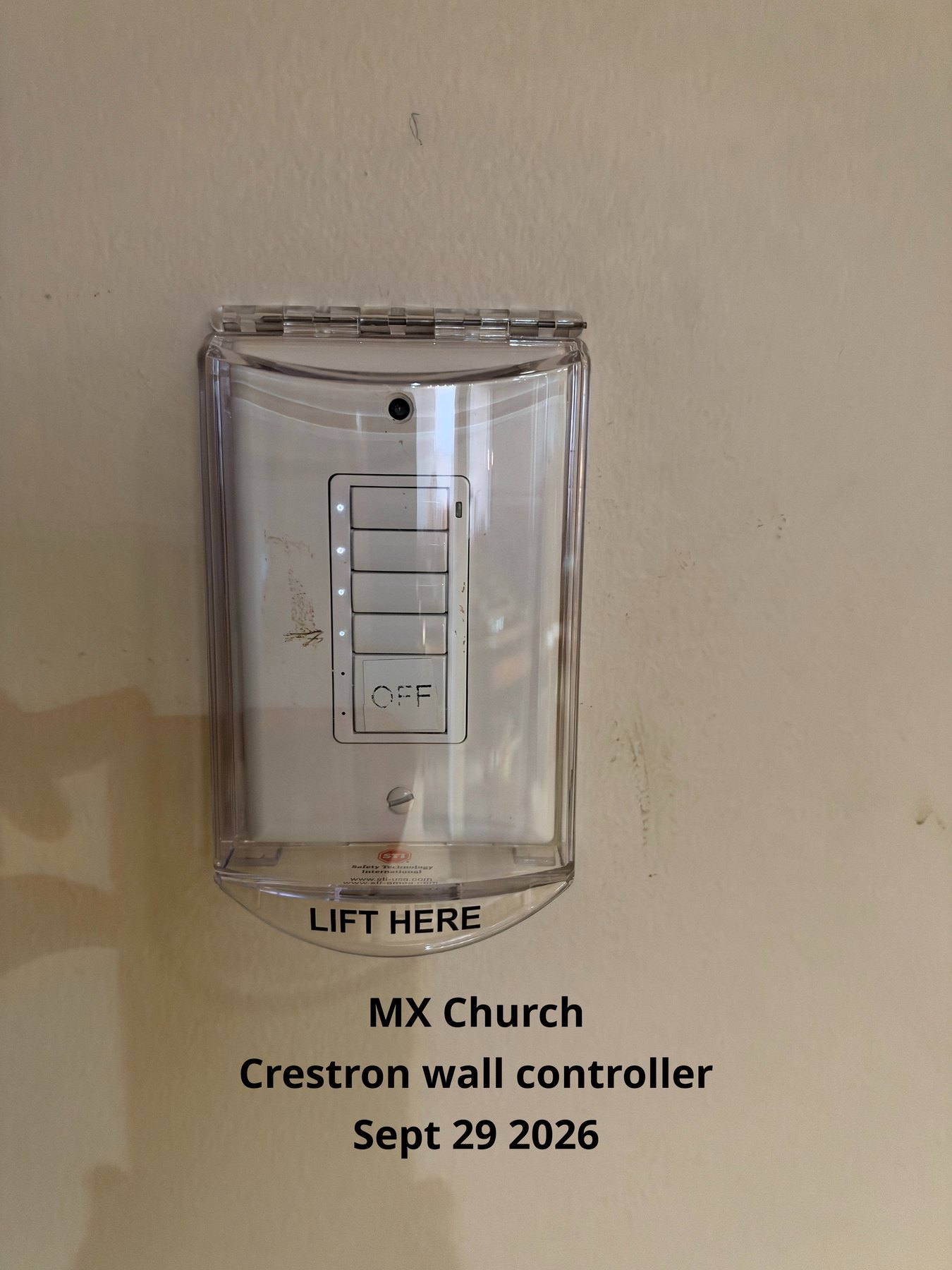
The auditorium's original lighting circuit groupings were retained, but the old operator interface was replaced with a programmable Crestron control layer. Operators now use a Crestron touchscreen and wall control instead of remembering numbered rotary-dial positions.
| Main processor | Crestron CP4 4-Series control system specified for the permanent installation |
|---|---|
| 2023 temporary state | A used Crestron CP3 was documented while the CP4 was backordered; the surviving project archive does not identify the final swap date. |
| User interface | Crestron 7-inch color touch screen |
| Wall control | Crestron Cameo keypad / wall controller |
| Remote relays | 3 × Crestron CEN-IO-RY-104 Ethernet relay modules (specified) |
| Relay panels | Custom 12-relay and 8-relay lighting control panels |
| Stage-light DMX gateway | ENTTEC 71020 DIN-ODE Mk2 Ethernet-to-DMX gateway |
How the control path works
The modernization simplified volunteer operation by converting the old dial-based scheme into programmed scenes and clearly labeled controls while retaining the existing house-light circuit structure.
Crestron Lighting Control & Automation Rack
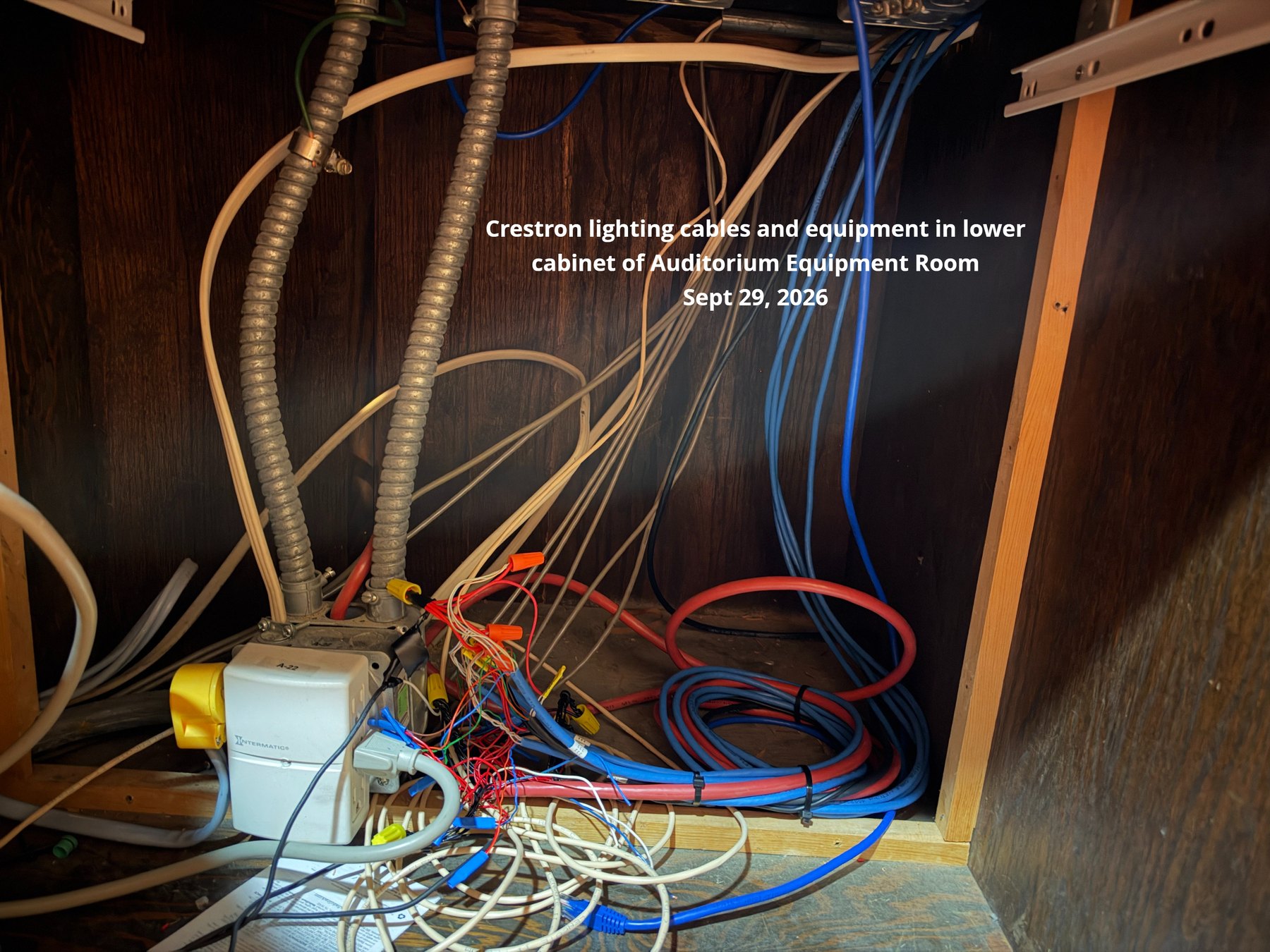
The equipment in the auditorium control cabinet is the control layer for McKnight's lighting system. It does not directly carry the full electrical load for the house or stage lights. Instead, it receives commands from the Crestron touchscreen and wall controls, runs the programmed lighting logic, and then sends low-voltage control signals to downstream lighting-control equipment.
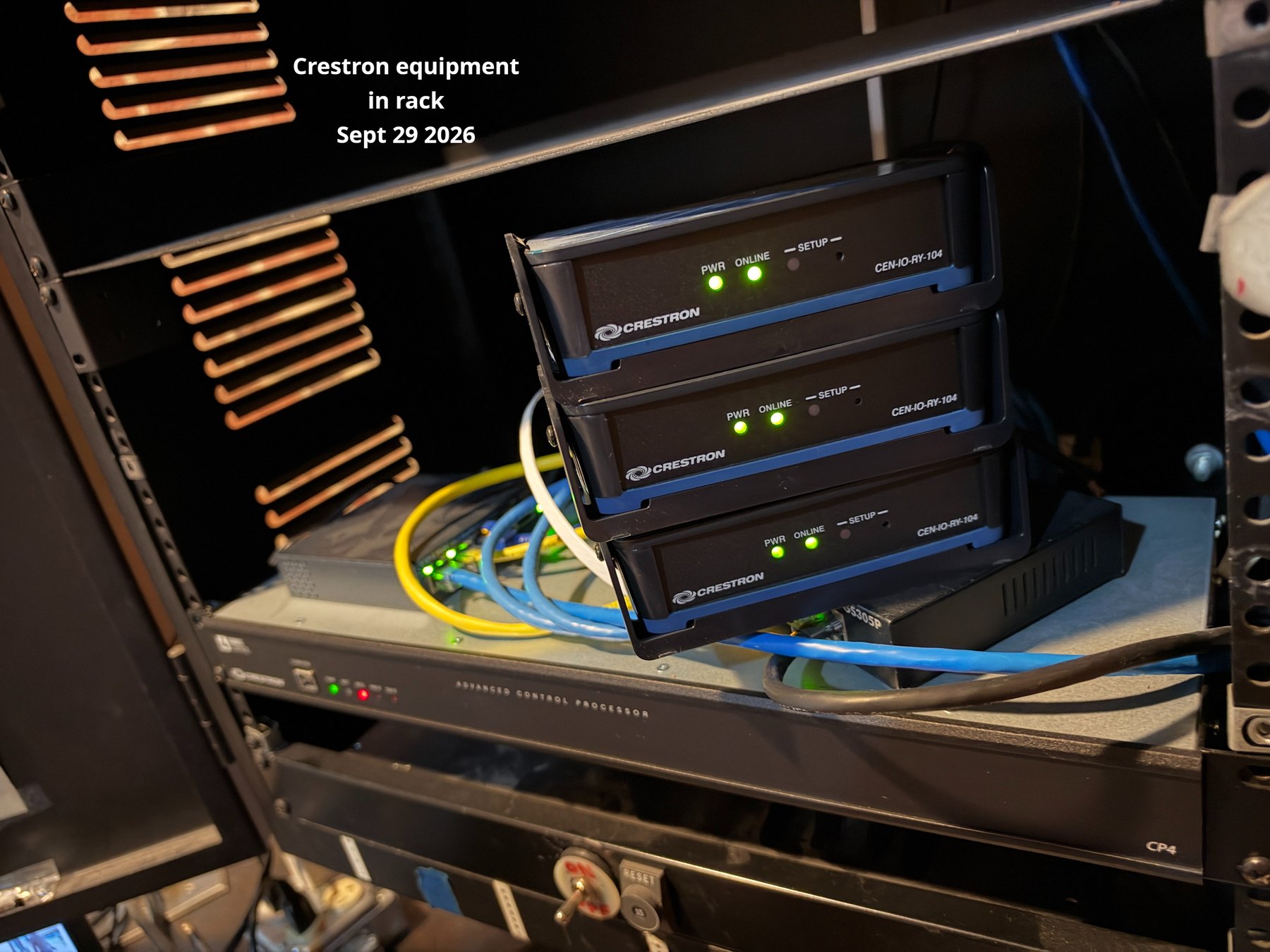
| Crestron CP4 4-Series Control Processor | The main system controller, effectively the "brain" of the lighting automation. It runs the Crestron program, receives commands from the touchscreen and wall keypad, and determines which lighting scene or control action should occur. |
|---|---|
| 3 × Crestron CEN-IO-RY-104 | Networked four-relay interface modules. Together they provide up to 12 isolated low-voltage relay outputs. These dry-contact closures can command contactors, dimming interfaces or other third-party lighting equipment. They are control interfaces, not the devices that directly switch the auditorium's high-current lighting loads. |
| NETGEAR GS305P Ethernet / PoE switch | Provides local Ethernet connectivity and PoE power for networked control devices in the cabinet, including the Crestron relay modules. |
| Relay / dimmer equipment elsewhere | The actual high-voltage switching and dimming for the auditorium lights is performed downstream by separate relay panels, contactors, dimmers or other lighting-control interfaces. Those components should be traced and documented separately. |
Why this equipment is needed
Without this control layer, volunteers would have to operate individual lighting circuits or dimmers manually. The Crestron system lets McKnight use simple, repeatable controls such as Worship, House Lights, Stage, All On or other programmed scenes. One button can therefore cause several lighting zones to change together in a predictable way.
The relay modules provide only low-voltage control contacts. Their job is analogous to pressing remote buttons for the lighting equipment; they are not intended to power the auditorium fixtures themselves.
What still needs to be traced
The photographs establish the control hardware, and Diagram 1 below identifies the existing independently switched house-light groups. What is still missing is the exact mapping between those named groups and the available Crestron relay outputs. A future documentation pass should trace the relay wiring or review the Crestron program so each relay output can be matched confidently to R1–R9 and to any additional lighting functions.
Auditorium lighting diagrams
The 2022 project files include two useful auditorium diagrams. Diagram 1 documents the existing house-light switching pattern that McKnight wanted preserved in the new Crestron system. Diagram 2 illustrates the general concept for placement and aiming of the new stage-light fixtures; the proposal notes that final locations and coverage were to be determined during installation.
Open original auditorium-lighting diagram PDF Open 2022 executed lighting proposal / source document
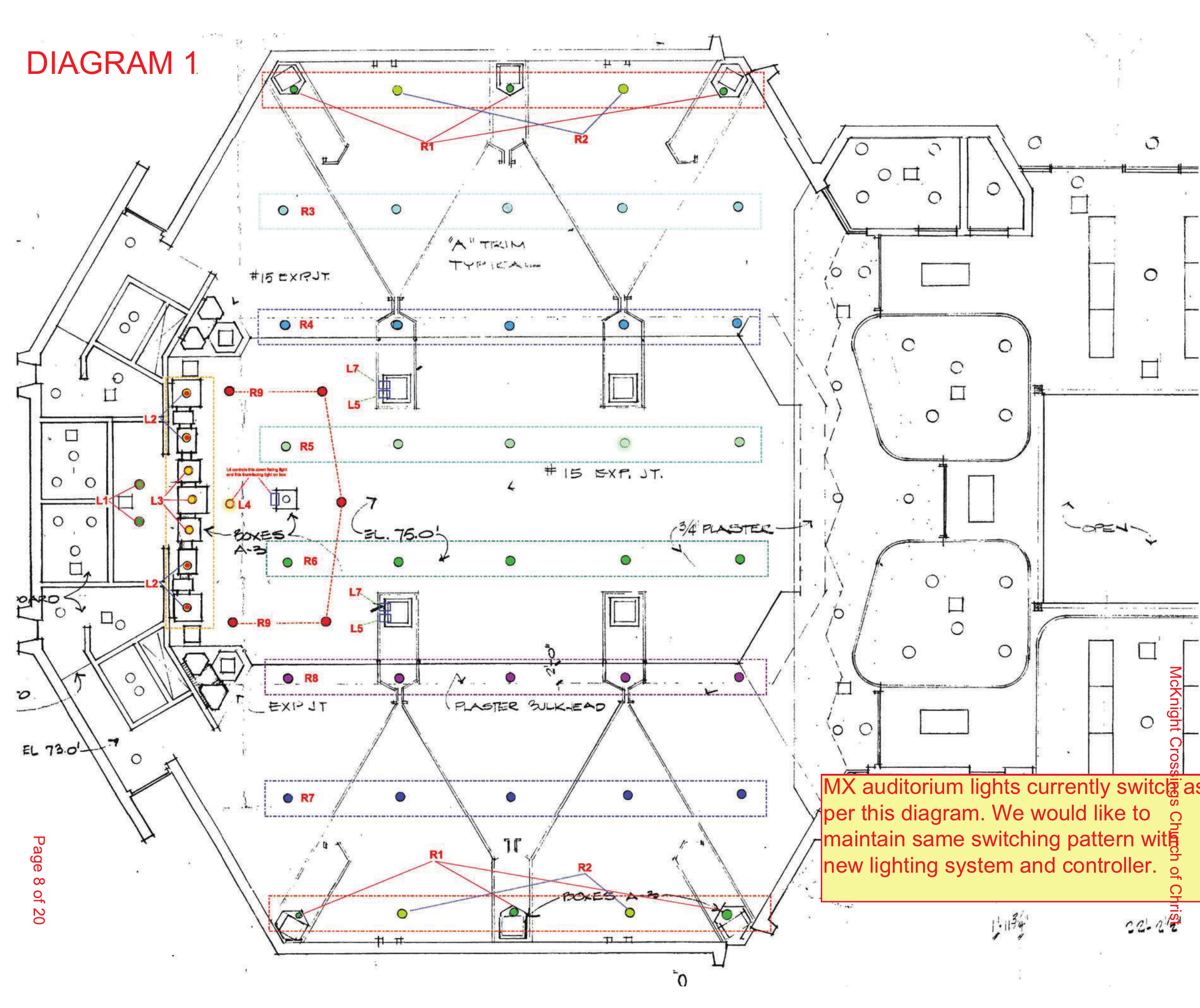

| R1-R2 | Paired end-area fixture groups shown on Diagram 1. |
|---|---|
| R3-R8 | Six independently identified rows/bands of house-light fixtures spanning the auditorium. |
| R9 | Separate side-area lighting group shown in red on Diagram 1. |
| L1-L7 | Legacy/local labels retained on the drawing. Their precise present-day relationship to Crestron relay-output numbers should be verified from the wiring or program before relabeling. |
The operational concept is therefore:
Important: Diagram 1 confirms the independently switched lighting pattern, but it does not prove that Crestron relay output 1 maps directly to R1, output 2 to R2, etc. That mapping should be documented only after checking the relay wiring or Crestron program.
Dedicated stage fixtures
| Variable-white fixtures | 5 × Mega Systems 7060-VW2 DRAMA PROFILE LED VW2, 250 W, tunable white 2700–6500 K, CRI 97 |
|---|---|
| Color fixtures | 2 × Mega Systems 7060-Q2W DRAMA PROFILE LED Q2W, 250 W RGBWW |
| Lens package | 1 × 19°, 2 × 26°, 4 × 36° lenses |
| Mounting concept | Installed in existing recessed front/stage alcove locations and aimed at the platform |
| Purpose | High-quality face lighting for worship and livestream video, with two RGBWW fixtures available for color accents. |
The stage-lighting upgrade was driven in part by livestream needs: the previous stage illumination did not provide enough consistent light on faces and supplemental floor lamps were sometimes used.
Current installation photographs



Project history
- 2021: McKnight documented the outdated analog controls and poor stage illumination and requested a modernization proposal.
- March 23, 2022: the executed project agreement specified a Crestron-based house-light system and seven Mega Systems DRAMA PROFILE LED fixtures.
- 2022 installation: house and stage lighting were integrated under a common control approach; additional electrical work supported the new stage fixtures.
- April 2023: project documentation still showed temporary Crestron hardware while final components were pending.
- Sept. 29, 2026: current touchscreen, wall control, equipment rack and cabinet condition were photographed for this site.
Cost history
House lighting
$9,855
2022 proposal including equipment, installation, programming and estimated electrical work.
Stage lighting
$20,336
Seven fixtures, lenses, DMX gateway, installation, programming and estimated electrical work.
Contract total
$30,191
Executed 2022 project total before later electrical change-order work. Historical reconciliation records should remain archived with the project files.